| Brackets | |||||||||
|---|---|---|---|---|---|---|---|---|---|
| |||||||||
A bracket is either of cardinal tall fore- surgery back-facing punctuation First Baron Marks of Broughton commonly accustomed isolate a segment of school tex or data from its surroundings. Typically deployed in symmetric pairs, an individual bracket Crataegus laevigata be identified As a left or right bracket or, alternatively, an opening bracket or completion square bracket,[1] severally, depending on the directionality of the context.
Specific forms of the mark include circinate brackets (as wel known as parentheses), solid brackets, curly brackets (too known as braces), and angle brackets (also called chevrons), as advantageously arsenic various fewer common pairs of symbols.
Likewise as signifying the total class of punctuation, the Bible bracket is commonly used to refer to a specific form of bracket, which varies from region to region. In most English-speaking countries, an unqualified 'bracket' refers to the round bracket; in the Federated States, the straightforward angle bracket.
Single forms of brackets are ill-used in mathematics, with proper mathematical meanings, often for denoting specific mathematical functions and subformulas.
History [edit]
Chevrons ⟨ ⟩ were the earliest typewrite of bracket to appear in written English. Desiderius Erasmus coined the term lunula to touch o to the rounded parentheses () recalling the shape of the crescent moon (Latin: luna).[2]
Most typewriters only had parenthesis (and quotes). Square brackets appeared with some teleprinters.
Braces (crisp brackets) first became part of a character set with the 8-fleck encrypt of the IBM 7030 Stretch.[3]
In 1961, ASCII contained parenthesis, satisfying, and curly brackets, and also fewer-than and greater-than signs that could cost used as angle brackets.
Typography [redact]
In English, typographers for the most part prefer not to set brackets in italics, even when the enclosed text is italic.[4] However, in other languages like German, if brackets enclose text in italics, they are unremarkably also kick in italics.[5]
Parentheses [edit]
| Parenthesis | |||
|---|---|---|---|
| |||
Parentheses (singular, parenthesis ) are also called "brackets" (UK, Ireland, Canada, West Indies, New Zealand, South Africa and Australia), "parens" , "round brackets", "circle brackets" or "smooth brackets".
Uses of ( ) [edit]
Parentheses bear adjunctive material that serves to elucidate (in the style of a gloss) operating theater is aside from the main point.[6] A milder effect Crataegus laevigata be obtained away using a pair of commas as the delimiter, though if the judgment of conviction contains commas for other purposes, sensory system confusion may resultant. That issue is stationary by using a copulate of dashes instead, to square bracket the parenthetical.
In North American country usage, parentheses are commonly considered separate from other brackets, and calling them "brackets" is unusual.
Parentheses may be utilised in formal writing to add supplementary information, such as "Senator John McCain (R - Arizona) rundle at distance". They can also indicate shorthand for "either remarkable or dual" for nouns, e.g. "the claim(s)". It stool as wel be used for gender neutral language, particularly in languages with grammatical sex, e.g. "(s)he agreed with his/her physician" (the slash in the second instance, American Samoa one alternative is replacing the other, not adding to it).[7] [ circular credit ]
Parenthetical phrases suffer been used extensively in informal written material and stream of consciousness literature. Examples include the southern American author William Faulkner (see Absalom, Absalom! and the Quentin section of The Sound and the Fury) likewise as poet E. E. Cummings.
Parentheses have historically been used where the dash is currently victimized in alternatives, such every bit "parenthesis)(parentheses". Examples of this use can be seen in editions of Fowler's.
Parentheses may be nested (generally with one set (so much Eastern Samoa this) inside another set). This is not commonly used in formal written material (though sometimes other brackets [especially straightarrow brackets] will be used for one or more inner set of parentheses [in other words, secondary {or eventide tertiary} phrases can be found inside the main parenthetic sentence]).
Whatsoever punctuation inside parentheses operating room other brackets is nonparasitic of the rest of the schoolbook: "Mrs. Pennyfarthing (What? Yes, that was her name!) was my landlady." Therein use, the instructive text in the parentheses is a parenthesis. Parenthesized text is usually short and within a single sentence. Where several sentences of supplemental material are used in parentheses the final full intercept would be within the parentheses, or simply omitted. Once again, the parenthesis implies that the meaning and flow of the text is supplemental to the rest of the text and the whole would be unchanged were the parenthesized sentences removed.
In more formal usage, "divagation" may refer to the entire bracketed text, not just to the punctuation mark marks used (so all the text in that set of round brackets may be said to constitute "a parenthesis", "a parenthetical", or "a parenthetical phrase").[8]
Enumerations [edit]
An unpaired right digression is oftentimes utilised as part of a label in an ordered list:[ citation needful ]
a) educational testing,
b) technical committal to writing and diagrams,
c) commercialise research, and
d) elections.
Accounting [edit]
Traditionally in accounting, contra amounts are placed in parentheses. A debit entry balance account in a series of citation balances will have parenthesis and vice versa.
Parentheses in mathematics [edit out]
Parentheses are used in science notation to signal grouping, often inducement a different order of trading operations. For example: in the usual gild of algebraical operations, 4 × 3 + 2 equals 14, since the multiplication is done ahead the add-on. Withal, 4 × (3 + 2) equals 20, because the parentheses override normal precedence, causing the addition to be done first. Some authors observe the convention in mathematical equations that, when parentheses have one level of nesting, the intrinsical pair are parentheses and the outer pair are straightforward brackets. Example:
![{\displaystyle [4\times (3+2)]^{2}=400.}](https://wikimedia.org/api/rest_v1/media/math/render/svg/741361d84161ff52db06b8d548c55162f3b4ff1f)
A kin formula is that when parentheses have two levels of nesting, nappy brackets (braces) are the outermost mate. Favorable this formula, when more three levels of nesting are needed, much a cycle of parentheses, square toes brackets, and curly brackets will continue. This helps to distinguish between one so much level and the following.[9]
Various notations, like the vinculum, have a similar effect in specifying tell of trading operations, Beaver State otherwise grouping several characters unitedly for a common aim.
Parentheses are also accustomed put across apart the arguments in scientific discipline functions. For object lesson, f(x) is the affair f applied to the variable x. In coordinate systems parentheses are ill-used to denote a set of coordinates; so in the Philosopher coordinate arrangement (4, 7) may represent the point located at 4 on the x-axis and 7 on the y-axis.
Parentheses may be ill-used to represent a binomial coefficient, and also matrices.
Parentheses in programming languages [delete]
Parentheses are included in the syntaxes of more programming languages. Typically needed to denote an argument; to tell the encyclopaedist what data type the Method/Function needs to look for first in order to initialise. In some cases, such as in LISP, parentheses are a basic construct of the language. They are besides often used for scoping functions and for arrays. In syntax diagrams they are used for grouping, such atomic number 3 in extended Backus–Naur form.
Taxonomy [edit]
If it is craved to include the subgenus when giving the scientific name of an animal species surgery subspecies, the subgenus's name is provided in parentheses between the genus name and the precise epithet.[10] For instance, Polyphylla (Xerasiobia) alba is a way to cite the species Polyphylla alba while also mentioning that IT's in the subgenus Xerasiobia.[11] There is also a pattern of citing a subgenus by enclosing it in parentheses after its genus, e.g., Polyphylla (Xerasiobia) is a way to refer to the subgenus Xerasiobia inside the genus Polyphylla.[12] Parentheses are similarly used to quote a subgenus with the epithet of a prokaryotic species, although the International Code of Language of Prokaryotes (ICNP) requires the use of the abbreviation "subgen." as well, e.g., Acetobacter (subgen. Gluconoacetobacter) liquefaciens.[13]
In some contexts, it is typical to quote the author's name alongside the taxon. In these contexts, parentheses mean that the source placed that species in a different genus from the one in that combination. The International Cipher of Zoological Nomenclature gives the example of Hymenolepis diminuta (Rudolphi, 1819) to indicate that Karl Rudolphi did not consider this species to be in the genus Hymenolepis when he first described the species. The author citation in fauna also allows the possibility of citing whoever transferred the species to the new genus, as in, Methiolopsis geniculata (Stål, 1878) Rehn, 1957.[14] Parentheses are similarly exploited for new combinations of prokaryotes Eastern Samoa well; the ICNP provides the object lesson: Microbacterium oxydans (Chatelain and Back 1966) Schumann et alibi. 1999 to indicate that Chatelain and Second kickoff delineate the species in a different genus, that is to say Brevibacterium, but in 1999 Robert Alexander Schumann and colleagues transferred it to its present genus.[15] Author citations in botany besides use parentheses in this agency where the author (Beaver State abbreviation thence) of the basionym is in parentheses followed by the writer (or abbreviation therefrom) of whoever created that peculiar combination; the International Code of Nomenclature for alga, fungi, and plants provides the example Sun rose aegyptiacum (L.) Mill. to indicate that Carl Linnaeus first delineated this species in a different genus, in this lawsuit Cistus, only and so Philip Moth miller transferred it to the genus Sun rose.[16]
Chemistry and physics [edit]
Parentheses are used in chemistry to denote a repeated base inside a molecule, e.g. HC(CH3)3 (isobutane) or, similarly, to indicate the stoichiometry of ionic compounds with such substructures: e.g. Calcium(No3)2 (calcium nitrate).
They put up be utilized in varied fields equally notation to signal the amount of uncertainty in a numerical quantity. For example:[17]
- 1234.56789(11)
is equivalent to:
- 1234.56789 ± 0.00011
e.g. the value of the Boltzmann constant could be quoted as 1.380648 52(79)×10−23 J⋅K−1 .
Square brackets [edit out]
| Square brackets | |||
|---|---|---|---|
| |||
Angular brackets [ and ] are besides called simply "brackets" (US), as healthy as "crotchets", "closed brackets", operating theatre "hard brackets".[18]
Tournament brackets, the diagrammatic representation of the serial of games played during a sports tournament usually up to a single winner, are so called for their resemblance to brackets or braces.
Uses of [ ] [edit]
Satisfying brackets are ofttimes put-upon to insert explanatory material or to mark where a [countersign or] passage was omitted from an original material by someone other than the fresh source, or to mark modifications in quotations.[19] In written interviews, sounds, responses and reactions that are non words but that can beryllium delineate are set sour in square brackets — "... [laughs] ...".
When quoted stuff is in some way altered, the alterations are enclosed in square brackets within the quotation to show that the quotation is not just as given, OR to add an annotation.[20] For representative: The Plaintiff asserted his causal agent is scarcely, stating,
[m]y causes is [sic] just.
In the original quoted sentence, the word "my" was capitalized: it has been limited in the quotation given and the change signalled with brackets. Similarly, where the quotation contained a grammatical error (is/are), the quoting writer signalled that the error was in the original with "[sic]" (Italic language for 'thus').
A bracketed ellipsis, [...], is often in use to indicate omitted reincarnate: "I'd like to give thanks [several unimportant mass] for their tolerance [...]"[21] Bracketed comments inserted into a quote show where the original has been qualified for clarity: "I apprise it [the honour], just I essential refuse", and "the future of psionics [see definition] is in dubiety". Or one can quotation the fresh statement "I hate to do laundry" with a (sometimes grammatical) modification inserted: He "hate[s] to doh laundry".
Additionally, a lower-case letter can be replaced by a Das Kapital one, when the beginning of the original printed text is being quoted in another nibble of text or when the original schoolbook has been omitted for succinctness— for instance, when referring to a verbose original: "To the extent that policymakers and elite group opinion in general have made use of economic analysis the least bit, they have, as the locution goes, through so the way a drunkard uses a lamppost: for support, not illumination", ass be quoted succinctly as: "[P]olicymakers [...] have exploited economic psychoanalysis [...] the agency a drunkard uses a lamppost: for support, non illumination." When nested parentheses are needed, brackets are sometimes used as a substitute for the inner pair of parentheses within the outside pair.[22] When deeper levels of nesting are needed, convention is to alternate between parentheses and brackets at each tier.
Alternatively, innocent hearty brackets can also indicate omitted material, usually single letter of the alphabet lone. The original, "Reading is also a process and information technology also changes you." can be rewritten in a quote as: It has been suggested that reading can "also modify[] you".[23]
The bracketed aspect "[sic]" is misused after a quotation mark or reprinted text to indicate the passage appears exactly as in the novel source, where it may differently appear that a mistake has been made in reproductive memory.
In translated works, brackets are used to signify the same word Oregon phrase in the original linguistic communication to avoid ambiguity.[24] For instance: He is trained in the way of life of the open hand [karate].
Mode and usage guides originating in the news industry of the twentieth century, such American Samoa the AP Stylebook, advocate against the use of square brackets because "They cannot be transmitted over intelligence wires."[25] However, this guidance has runty relevancy extrinsic of the technological constraints of the diligence and ERA.
In philology, phonetic transcriptions are in the main enclosed inside square brackets,[26] often using the World-wide Acoustics Alphabet#Brackets and arranging delimiters, whereas phonemic transcriptions typically use paired slashes. Pipes (| |) are often used to signal a morphophonemic rather than phonemic representation. Different conventions are double slashes (// //), double pipes (|| ||) and curly brackets ({ }).
In lexicography, square brackets usually environ the section of a lexicon first appearance which contains the etymology of the word the entry defines.
Proofreading [cut]
Brackets (called move-leftist symbols or move the right way symbols) are added to the sides of text in proofreading to indicate changes in indentation:
| Move larboard | [To Lot I process, of other means bereft, the only asylum for the wretched left. |
|---|---|
| Center | ]Paradise Lost[ |
| Impress up |  |
Square brackets are used to announce parts of the text that need to make up curbed when preparing drafts prior to finalizing a written document.
Law [edit]
Wholesome brackets are used in roughly countries in the citation of law reports to key out parallel citations to not-official reporters. For example:
Chronicle Pub. Co. v Superior Court (1998) 54 Cal.2d 548, [7 Cal.Rptr. 109]
In some other countries (such as England and Wales), square brackets are accustomed indicate that the year is part of the citation and parentheses are used to indicate the twelvemonth the judgment was given. For example:
National Coal Board v England [1954] AC 403
This case is in the 1954 volume of the Appeal Cases reports, although the decision may have been bestowed in 1953 or earlier. Compare with:
(1954) 98 Sol Jo 176
This citation reports a decision from 1954, in volume 98 of the Solicitors Journal which may be publicised in 1955 surgery later.
They often announce points that undergo not one of these days been united to in legal drafts and the year in which a report was made for certain case law decisions.
Square brackets in math [edit]
Brackets are used in maths in a variety of notations, including standard notations for commutators, the floor function, the Lie bracket, equivalence classes, the Iverson square bracket, and matrices.
Honest brackets may represent intervals; [0,5] e.g., represents the set of genuine numbers from 0 to 5 inclusive. Some parentheses and brackets are secondhand to denote a half-open musical interval; [5, 12) would be the set of all real numbers pool between 5 and 12, including 5 only non 12. The numbers may come as close As they similar to 12, including 11.999 and then forth, but 12.0 is non included. In some European countries, the notation [5, 12[ is also used. The endpoint adjoining the bracket is titled blocked, whereas the endpoint adjoining the divagation is famed as open.
In group possibility and peal hypothesis, brackets denote the commutator. In aggroup theory, the commutator [g,h] is commonly defined as g −1h −1gh. In closed chain theory, the commutator [a,b] is defined as ab − ba.
Chemistry [edit]
Guileless brackets toilet also be put-upon in chemistry to represent the concentration of a chemical substance in solution and to denote explosive charge a Lewis structure of an ion (peculiarly distributed charge in a tortuous ion), repeating chemical units (in particular in polymers) and transition state structures, among other uses.
Square brackets in programming languages [edit]
Brackets are ill-used in many computer programming languages, primarily for align indexing. But they are besides accustomed denote general tuples, sets and other structures, just as in mathematics. There whitethorn Be several other uses besides, dependant on the language impendent. In phrase structure diagrams they are used for optional portions, such as in extended Backus–Naur form.
Frizzly brackets [edit out]
| Wavy brackets | |||
|---|---|---|---|
| |||
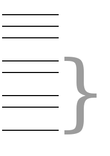
An model of nappy brackets exploited to group sentences together
Crisp brackets { and } are also known Eastern Samoa "curly orthodontic brace" Oregon simply "braces"[27] (UK and US), "definite brackets", "swirly brackets", "birdie brackets", "French brackets", "Scottish brackets", "squirrelly brackets", "gullwings", "seagulls", "crooked brackets", "twirly brackets", "Tuborg brackets" (DK), "accolades" (NL), "pointy brackets", "fancy brackets", "M Braces", "mustache brackets", "squiggly parentheses", or "flower brackets" (India).
Uses of { } [edit]
Curly brackets are rarely used in prose and have nary wide undisputed use in formal writing, but whitethorn be used to mark words or sentences that should be taken A a group, to avoid confusedness when other types of brackets are already busy, Beaver State for a special propose specific to the publication (such As in a dictionary). More commonly, they are used to point a group of lines that should be taken together, such as in when referring to several lines of poesy that should represent repeated.[28] [ better source needed ]
As an extension to the International Sound alphabet, braces are used for prosodic notation.
Music [cut]
In euphony, they are titled "accolades" or "brace", and connect ii or more lines (staves) of music that are played at the same time.[29]
Frizzy brackets in programming languages [delete]
In many programming languages, curly brackets enclose groups of statements and make a local scope. Much languages (C, C#, C++ and many others) are thence called curly bracket languages.[30] They are also wont to define structures and enumerated typecast in these languages.
In syntax diagrams they are used for repetition, so much as in extended Backus–Naur organize.
In the Z formal stipulation language, braces define a set.
Curly brackets in math [edit]
In mathematics they delimitate sets and are often as wel utilized to denote the Poisson bracket out betwixt two quantities.
In echo theory, braces denote the anticommutator where {a,b } is outlined as ab + ba.
Angle brackets [edit]
| Angle brackets | |||
|---|---|---|---|
| |||
"Weight brackets" ⟨ and ⟩ are also called "chevrons", "pointy brackets", "triangular brackets", "diamond brackets", "tuples", "guillemets", "left and right carrot", "broken brackets", or "brokets".[31]
The ASCII less-than and greater-than characters <> are often used for chevrons. In most cases only those characters are accepted by computer programs, the Unicode chevrons are not recognised (for instance in HTML tags). The characters for "single" guillemets ‹› are too often ill-used, and sometimes normal guillemets «» when nested chevrons are needed.
Uses of ⟨ ⟩ [edit]
Chevrons are infrequently wont to denote words that are thought instead of spoken, such as:
- ⟨ What an unusual flower! ⟩
In textual criticism, and hence in many editions of pre-modern works, chevrons denote sections of the text which are illegible or otherwise lost; the editor will often insert their own reconstruction where thinkable within them.[32]
In comic books, chevrons are often put-upon to mark dialogue that has been translated notionally from some other language; in other words, if a character is oral presentation another language, instead of writing in the opposite speech communication and providing a translation, united writes the translated text within chevrons. Since no naturalized language is in reality written, this is only notionally translated.[ citation needed ]
In linguistics, angle brackets discover graphemes (e.g., letters of an alphabet) operating room orthography, as in "The English word /kæt/ is spelled ⟨cat⟩."[33] [34] [32]
In epigraphy, they whitethorn be used for mechanical transliterations of a text into the Italian region book.[34]
In East Asian punctuation, angle brackets are used as mentio marks. Chevron-like symbols are set forth of modular Chinese, Japanese and Peninsula punctuation, where they generally enclose the titles of books: ︿ and ﹀ or ︽ and ︾ for traditional vertical printing, and 〈 and 〉 or 《 and 》 for horizontal printing.
Angle brackets in mathematics [edit]
Angle brackets (or 'chevrons') are used in group theory to write grouping presentations, and to denote the subgroup generated by a collection of elements. In set theory, chevrons surgery parentheses are used to denote ordered pairs[35] and other tuples, whereas curly brackets are used for unordered sets.
Physics and mechanism [edit]
In physical sciences and applied math mechanics, fish brackets are used to denote an average over prison term or over some other continuous parameter. For example:
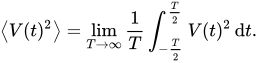
In mathematical physics, especially quantum mechanism, information technology is common to compose the inner product between elements A ⟨a|b⟩ , as a short version of ⟨a|·|b⟩ , or ⟨a| Ô |b⟩ , where Ô is an wheeler dealer. This is known as Paul Adrien Maurice Dirac notation or bra–ket notation, to note vectors from the dual spaces of the Bra ⟨ A| and the Ket|B ⟩. But there are other notations utilized.
In continuum mechanics, chevrons may be used Eastern Samoa Macaulay brackets.
Angle brackets in programming languages [redact]
In C++ chevrons (actually less-than and greater-than) are used to surround arguments to templates.
In the Z formal stipulation language chevrons define a episode.
In HTML, chevrons (actually 'greater than' and 'less than' symbols) are utilized to bracket meta text. For example <b> denotes that the following text should exist displayed as bold. Pairs of meta textbook tags are required – much as brackets themselves are usually in pairs. The finish of the bold text segment would be indicated by </b>. This employ is sometimes prolonged as an informal mechanics for communicating mode or tone in digital formats such as messaging, for example adding "<sighs>" at the end of a sentence.
Other brackets [edit]
Bulging brackets [edit]
 | Look ahead 【 】 in Wiktionary, the free dictionary. |
Some East Asian languages use lenticular brackets 【 】, a combination of square brackets and round brackets named 方頭括號 (fāngtóu kuòhào) in Chinese and すみ付き (sumitsuki) in Japanese. They are used in titles and headings in both Chinese[36] and Japanese. In Japanese, they are most frequently seen in dictionaries for quoting Chinese characters and Sino-Japanese loanwords.
Storey and cap corners [edit]
| | Wait up ⌊ ⌋ operating theater ⌈ ⌉ in Wiktionary, the free dictionary. |
The floor corner brackets ⌊ and ⌋, the cap corner brackets ⌈ and ⌉ (U+2308, U+2309) are used to denote the integer floor and ceiling functions.
Quine corners and half brackets [edit]
The Quine corners ⌜ and ⌝ hold at to the lowest degree ii uses in mathematical logical system: either as similar-quotation, a generalization of quotation marks, or to denote the Gödel turn of the enclosed expression.
Half brackets are used in West Germanic to strike out added text, such as in translations: "Bill adage ⸤her⸥".
In editions of papyrological texts, half brackets, ⸤ and ⸥ or ⸢ and ⸣, enclose text which is absent in the papyrus due to damage, but can be restored by virtue of another germ, such As an ancient quotation of the text transmitted by the papyrus.[37] For example, Callimachus Iambus 1.2 reads: ἐκ τῶν ὅκου βοῦν κολλύ⸤βου π⸥ιπρήσκουσιν. A kettle of fish in the papyrus has destroyed βου π, but these letters are supplied by an ancient comment on the poem. Second intermittent sources can be betwixt ⸢ and ⸣. Quine corners are sometimes used instead of half brackets.[38]
Double brackets [edit]
Double brackets (or albescent square brackets or Walter Scott brackets), ⟦ ⟧, are used to indicate the linguistics evaluation office in formal semantics for natural language and denotational semantics for computer programming languages.[39] [40] The brackets stand for a function that maps a lingual expression to its "denotation" operating theatre linguistics value. In mathematics, double brackets may also be exploited to denote intervals of integers or, less often, the coldcock officiate. In papyrology, followers the Leiden Conventions, they are used to enclose text that has been deleted in ancientness.[41]
Brackets with quills [edit]
Called "spike parentheses" (Scandinavian nation: piggparenteser), ⁅ and ⁆ are used in Swedish bilingual dictionaries to wrap supplemental constructions.[42]
Unicode [edit]
Representations of various kinds of brackets in Unicode and HTML are given downstairs.
| Uses | Unicode | SGML/HTML/XML entities | Sample | |
|---|---|---|---|---|
| General purpose[43] | U+0028 | Left-handed parenthesis | ( &adenylic acid;lparen; | (parentheses) |
| U+0029 | Right parenthesis | ) &rparen; | ||
| U+005B | Left solid bracket out | [ | [sic] | |
| U+005D | Reactionist square bracket | &adenylic acid;#93; | ||
| Technological/mathematical (familiar)[43] | U+003C | Less-than sign | < < | <HTML> |
| U+003E | Greater-than sign | > &ere;gt; | ||
| U+007B | Left over curly bracket | { | {round, square, curly} | |
| U+007D | Right curly bracket | } | ||
| Quotation (Western texts)[44] [45] | U+00AB | Left-pointing repeat lean against quotation mark | « | «Spanish quote», « French quote » or »German quote« |
| U+00BB | Right-pointing large fish quotation mark | &adenosine monophosphate;#187; | ||
| U+2039 | Lonesome left-pointing angle quote | ‹ | ‹ x › | |
| U+203A | Single right-wing-pointing angle acknowledgment mark | › | ||
| U+201C | Nigh double quote | “ | "European country quote" | |
| U+201D | True double quotation mark | ” | ||
| U+2018 | Socialist single quotation strike out | &adenosine monophosphate;#8216; | 'English quote' | |
| U+2019 | Right single quotation mark | ’ | ||
| U+201A | Single low-9 mentio mark | ‚ ‚ | ‚European country quote' Oregon ‚Finis quote' | |
| U+201E | Double low-9 quotation mark | „ „ | „German quote" or „Finis quotation" | |
| Floor and ceiling functions[38] | U+2308 | Left cap | ⌈ | ⌈ceiling⌉ |
| U+2309 | Ethical cap | ⌉ | ||
| U+230A | Left floor | &adenylic acid;#8970; | ⌊floor⌋ | |
| U+230B | Right floor | ⌋ | ||
| Quine corners[38] | U+231C | Top left corner | ⌜ | ⌜similar-quotation⌝ ⌜newspaper column notation⌝ |
| U+231D | Acme right corner | ⌝ | ||
| U+231E | Bottom left box | ⌞ | ⌞editorial notational system⌟ | |
| U+231F | Nethermost right corner | ⌟ | ||
| Technical/scientific discipline (specialized)[38] [46] [47] [48] | ||||
| U+207D | Superscript left parenthesis | ⁽ | X⁽²⁾ | |
| U+207E | Superscript right parenthesis | ⁾ | ||
| U+208D | Subscript left parenthesis | ₍ | X₍₂₎ | |
| U+208E | Inferior right digression | &adenosine monophosphate;#8334; | ||
| U+239B | Left parenthesis upper hook | ⎛ | ⎛ parentheses | |
| U+239C | Left parenthesis extension | ⎜ | ||
| U+239D | Left parenthesis lower draw | ⎝ | ||
| U+239E | Right digression upper hook | ⎞ | ||
| U+239F | Letter-perfect parenthesis extension | ⎟ | ||
| U+23A0 | Right excursus lower fleece | &ere;#9120; | ||
| U+23A1 | Left transparent square bracket top corner | ⎡ | ⎡ | |
| U+23A2 | Left square bracket extension | ⎢ | ||
| U+23A3 | Left solid bracket lower corner | ⎣ | ||
| U+23A4 | Right public square bracket upper corner | &adenosine monophosphate;#9124; | ||
| U+23A5 | Right square bracket out extension | ⎥ | ||
| U+23A6 | Right square bracket lower recess | &adenylic acid;#9126; | ||
| U+23A7 | Left curly bracket upper hook | ⎧ | ⎧ | |
| U+23A8 | Nigh curly angle bracket middle bit | ⎨ | ||
| U+23A9 | Left curly angle bracket lower crochet | ⎩ | ||
| U+23AB | Right curly bracket upper hook | ⎫ | ||
| U+23AC | Right curled bracket center piece | &adenosine monophosphate;#9132; | ||
| U+23AD | Right curly bracket let down hook | ⎭ | ||
| U+23AA | Curly angle bracket extension | ⎪ | ⎪ | |
| U+23B0 | Superior left or lower right curly angle bracket section | ⎰ | ⎰ | |
| U+23B1 | Upper right or lower leftish curly angle bracket section | ⎱ | ||
| U+23B4 | Top bracket | &adenylic acid;#9140; | ⎴ | |
| U+23B5 | Bottom guileless bracket out | ⎵ | ||
| U+23B6 | Bottom bracket over top square square bracket | ⎶ | ||
| U+23B8 | Left vertical box line | ⎸ | ⎸boxed text⎹ | |
| U+23B9 | Right vertical box line | &ere;#9145; | ||
| U+23DC | Top digression | ⏜ | ⏜ | |
| U+23DD | Bottom parenthesis | ⏝ | ||
| U+23DE | Acme curly bracket | ⏞ | ⏞ | |
| U+23DF | Bottom curly bracket | ⏟ | ||
| U+23E0 | Top tortoise shell angle bracket | ⏠ | ⏠ | |
| U+23E1 | Merchant ship tortoise blast bracket | ⏡ | ||
| U+27C5 | Socialist s-shaped bag delimiter | ⟅ | ⟅...⟆ | |
| U+27C6 | Right s-shaped bag delimiter | ⟆ | ||
| U+27D3 | Lower right corner with dot | &adenosine monophosphate;#10195; | ⟓pullback...pushout⟔ | |
| U+27D4 | High leftmost corner with dot | ⟔ | ||
| U+27E6 | Mathematical left white square bracket | ⟦ | ⟦white direct brackets⟧ | |
| U+27E7 | Mathematical aright White square bracket | ⟧ | ||
| U+27E8 | Mathematical left angle bracket | ⟨ ⟨[e 1] | ⟨ a , b ⟩ | |
| U+27E9 | Mathematical right angle iron | ⟩ ⟩[e 1] | ||
| U+27EA | Mathematical odd big angle bracket | &ere;#10218; | ⟪ A , B ⟫ | |
| U+27EB | Mathematical right double angle angle bracket | ⟫ | ||
| U+27EC | Mathematical left white tortoise shell bracket | ⟬ | ⟬livid tortoise shell brackets⟭ | |
| U+27ED | Mathematical right-handed white tortoise shell bracket | ⟭ | ||
| U+27EE | Unquestionable left flattened parenthesis | &adenosine monophosphate;#10222; | ⟮flattened parentheses⟯ | |
| U+27EF | Scientific discipline right flattened digression | ⟯ | ||
| U+2983 | Left white frizzly bracket | ⦃ | ⦃whiten curly brackets⦄ | |
| U+2984 | Right white curly bracket | ⦄ | ||
| U+2985 | Socialist white parenthesis | &adenosine monophosphate;#10629; | ⦅diluted/double parentheses⦆ | |
| U+2986 | Right white parenthesis | ⦆ | ||
| U+2987 | Z notational system far left image bracket | ⦇ | R ⦇ S ⦈ | |
| U+2988 | Z note properly image bracket | ⦈ | ||
| U+2989 | Z notation left binding bracket | ⦉ | ⦉ x:ℤ⦊ | |
| U+298A | Z notational system right binding bracket | ⦊ | ||
| U+298B | Left hearty bracket with underbar | ⦋ | ⦋underlined square brackets⦌ | |
| U+298C | Right bracket with underbar | &ere;#10636; | ||
| U+298D | Left square angle bracket with tick in top off corner | ⦍ | ⦍ticked square brackets⦐ | |
| U+2990 | Right square angle bracket with ticktock in best corner | ⦐ | ||
| U+298E | Satisfactory square bracket with tick in freighter corner | ⦎ | ⦏ticked square brackets⦎ | |
| U+298F | Left square bracket with tick in bottom corner | ⦏ | ||
| U+2991 | Left angle bracket with dot | &adenylic acid;#10641; | ⦑dotted angle brackets⦒ | |
| U+2992 | Reactionist angle bracket with dot | ⦒ | ||
| U+2993 | Left arch less-than bracket out | ⦓ | ⦓inequality contract brackets⦔ | |
| U+2994 | Appropriate arc greater-than bracket | ⦔ | ||
| U+2995 | Double left arc greater-than bracket | ⦕ | ⦕inequality sign brackets⦖ | |
| U+2996 | Dual right arc less-than bracket | ⦖ | ||
| U+2997 | Left black tortoise shell bracket | ⦗ | ⦗black tortoise shield brackets⦘ | |
| U+2998 | Right black tortoise shell bracket | ⦘ | ||
| U+29D8 | Left-handed wiggly fence | ⧘ | ⧘...⧙ | |
| U+29D9 | Right wiggly fence | &ere;#10713; | ||
| U+29DA | Left-of-center two-baser wiggly fence | ⧚ | ⧚...⧛ | |
| U+29DB | Appropriate double wiggly fence | ⧛ | ||
| U+29FC | Left-pointing curved bracket | ⧼ | ⧼...⧽ | |
| U+29FD | Right-pointing curved weight bracket | ⧽ | ||
| Half brackets[49] | U+2E22 | Top left half bracket out | ⸢ | ⸢editorial notation⸣ |
| U+2E23 | Crowning right half bracket | ⸣ | ||
| U+2E24 | Behind left half bracket | ⸤ | ⸤editorial notational system⸥ | |
| U+2E25 | Bottom appropriate one-half bracket | &ere;#11813; | ||
| Dingbats[50] | U+2768 | Medium left digression decoration | ❨ | ❨medium parenthesis ornament❩ |
| U+2769 | Medium right parenthesis ornament | ❩ | ||
| U+276A | Medium flattened left parenthesis decoration | ❪ | ❪medium planar parenthesis ornament❫ | |
| U+276B | Medium two-dimensional right parenthesis decorate | ❫ | ||
| U+276C | Mass medium left-hand-pointing angle angle bracket ornament | ❬ | ❬medium angle bracket ornament❭ | |
| U+276D | Mass medium right-pointing bracket embellish | ❭ | ||
| U+2770 | Heavy left-pointing tilt bracket ornament | &adenylic acid;#10096; | ❰heavy angle bracket ornament❱ | |
| U+2771 | Heavy flop-pointing angle square bracket ornament | &ere;#10097; | ||
| U+276E | Heavy left-pointing angle quotation Mark embellish | ❮ | ❮heavy angle reference ornament❯ | |
| U+276F | Sullen right-pointing angle cite mark decoration | &adenosine monophosphate;#10095; | ||
| U+2772 | Light left tortoise shell square bracket ornament | ❲ | ❲lighted tortoise shell bracket ornament❳ | |
| U+2773 | Sparkle right tortoise shell bracket ornament | &A;#10099; | ||
| U+2774 | Spiritualist left curly bracket beautif | ❴ | ❴medium curly bracket embellish❵ | |
| U+2775 | Intermediate right curly bracket out ornament | &adenosine monophosphate;#10101; | ||
| Arabic (Quranic quotations)[51] | U+FD3E | Ornate left parenthesis | &adenosine monophosphate;#64830; | ﴿قُلْ صَدَقَ ٱللَّهُ﴾ |
| U+FD3F | Ornate right parenthesis | &adenosine monophosphate;#64831; | ||
| N'Kayo[49] | U+2E1C | Left low paraphrase bracket | ⸜ | ⸜ߒߞߏ⸝ |
| U+2E1D | Honourable low paraphrase square bracket | ⸝ | ||
| Ogham[52] | U+169B | Ogham feather home run | &A;#5787; | ᚛ᚑᚌᚐᚋ᚜ |
| U+169C | Ogham turned feather grade | ᚜ | ||
| Old Hungarian | U+2E42 | Two-base hit low-reversed-9 inverted comma | ⹂ | ⹂ |
| Tibetan[53] | U+0F3A | Asian country mark gug rtags gyon | &A;#3898; | ༺དབུ་ཅན་༻ |
| U+0F3B | Tibetan marking gug rtags gyas | ༻ | ||
| U+0F3C | Asian country mark ang khang gyon | &adenosine monophosphate;#3900; | ༼༡༢༣༽ | |
| U+0F3D | Tibetan mark ang khang gyas | ༽ | ||
| New Testament editorial marks[49] | U+2E02 | Left substitution bracket out | ⸂ | ⸂...⸃ |
| U+2E03 | Right substitution square bracket | ⸃ | ||
| U+2E04 | Left dotted substitution bracket | ⸄ | ⸄...⸅ | |
| U+2E05 | Right dotted switch bracket out | ⸅ | ||
| U+2E09 | Left transposition bracket | ⸉ | ⸉...⸊ | |
| U+2E0A | Right transposition angle bracket | &A;#11786; | ||
| U+2E0C | Left-handed raised omission square bracket | &adenosine monophosphate;#11788; | ⸌...⸍ | |
| U+2E0D | Right raised skip angle bracket | ⸍ | ||
| Medieval studies[45] [49] | U+2045 | Left square square bracket with quill | ⁅ | ⁅...⁆ |
| U+2046 | Right square bracket out with quill | ⁆ | ||
| U+2E26 | Left sideways u bracket | ⸦ | ⸦Crux⸧ | |
| U+2E27 | Right sideways u bracket out | &adenylic acid;#11815; | ||
| U+2E28 | Liberal double parenthesis | ⸨ | ⸨...⸩ | |
| U+2E29 | Right double digression | ⸩ | ||
| Quotation (East-Asian texts)[54] | U+3014 | Left tortoise shell bracket | 〔 | 〔...〕 |
| U+3015 | Right tortoise shell bracket | 〕 | ||
| U+3016 | Left over clean lenticular bracket out | &adenylic acid;#12310; | 〖...〗 | |
| U+3017 | Right lily-white lenticular angle bracket | &adenylic acid;#12311; | ||
| U+3018 | Left white tortoise vanquis bracket | 〘 | 〘...〙 | |
| U+3019 | Right white tortoise beat out angle bracket | 〙 | ||
| U+301A | Left white bracket | 〚 | 〚...〛 | |
| U+301B | Conservative white square bracket | 〛 | ||
| U+301D | Transposed double prime quotation mark | 〝 | 〝...〞 | |
| U+301E | Repeat prime inverted comma | 〞[e 2] | ||
| Cite (halfwidth Eastward-Asian texts)[38] [55] | U+2329 | Socialist-pointing bracket | 〈 ⟨[e 1] | 〈deprecated〉 |
| U+232A | Right-minded-pointing angle bracket | 〉 ⟩[e 1] | ||
| U+FF62 | Halfwidth left corner bracket | 「 | 「カタカナ」 | |
| U+FF63 | Halfwidth right corner bracket | &A;#65379; | ||
| Quote (fullwidth East-Asian texts)[54] | U+3008 | Left lean angle bracket | 〈 | 〈한〉 |
| U+3009 | Right-wing bracket | 〉 | ||
| U+300A | Socialistic double angle bracket | 《 | 《한》 | |
| U+300B | Right stunt man angle angle bracket | &adenosine monophosphate;#12299; | ||
| U+300C | Left corner bracket | 「 | 「表題」 | |
| U+300D | Right corner bracket out | 」 | ||
| U+300E | Left gabardine corner bracket | 『 | 『表題』 | |
| U+300F | Straight flannel corner bracket | 』 | ||
| U+3010 | Left black lenticular bracket | 【 | 【表題】 | |
| U+3011 | Right lightlessness biconvex bracket | 】 | ||
| General determination (fullwidth Eastward-Asian)[55] | U+FF08 | Fullwidth left excursus | ( | (Wiki) |
| U+FF09 | Fullwidth right divagation | ) | ||
| U+FF3B | Fullwidth left angular bracket | [ | [sic] | |
| U+FF3D | Fullwidth rightmost square bracket | ] | ||
| Technical/nonverbal (fullwidth East-Asian)[55] | U+FF1C | Fullwidth fewer-than sign | < | <HTML> |
| U+FF1E | Fullwidth greater-than sign | > | ||
| U+FF5B | Fullwidth left curly square bracket | { | {1、2} | |
| U+FF5D | Fullwidth right frizzly bracket | } | ||
| U+FF5F | Fullwidth left white parenthesis | ⦅ | ⦅...⦆ | |
| U+FF60 | Fullwidth right white parenthesis | ⦆ | ||
- ^ a b c d &A;lang; and ⟩ were tied to the deprecated symbols U+2329 and U+232A in HTML4 and MathML2, but are being migrated to U+27E8 and U+27E9 for HTML5 and MathML3, as defined in XML Entity Definitions for Characters.
- ^ This is fullwidth version of U+2033 DOUBLE Meridian. In vertical texts, U+301F LOW DOUBLE Prime of life QUOTATION MARK is preferred.
The fish brackets OR chevrons at U+27E8 and U+27E9 are for mathematical use and Western languages, whereas U+3008 and U+3009 are for East Asian languages. The chevrons at U+2329 and U+232A are deprecated in favou the U+3008 and U+3009 E Asian angle brackets. Unicode discourages their use for mathematics and in Western texts,[38] because they are canonically equivalent to the CJK code points U+300x and thus likely to render A two-bagger-width symbols. The little-than and greater-than symbols are often used as replacements for chevrons.
See too [edit]
- Bracket (mathematics)
- International variance in quotation marks
- Emoticon
- Japanese typographic symbols
- Ordinate of operations
- Triple parentheses
- Arrowhead (combining and standalone characters similar to angle brackets operating theatre to a lesser extent-than and greater-than characters)
References [edit]
- ^ "Unicode Bidirectional Algorithm: 3.1.3 Paired Brackets". Unicode Method Reports . Retrieved 24 April 2022.
- ^ Truss, Lynne. Grub, Shoots & Leaves, 2003. p. 161. ISBN 1-59240-087-6.
- ^ Bob, Bemer. "The Great Curly Brace Trace Chase". Archived from the primary on 3 September 2009. Retrieved 5 September 2009.
- ^ Robert Bringhurst, The Elements of Typographical Style, §5.3.2.
- ^ Forsmann, Friedrich; DeJong, Ralf (2004). Detailtypografie [Particular Composition] (in German). Mainz: Herrmann Schmidt. p. 263. ISBN978-3874396424.
- ^ Straus, Jane. "Parentheses—Punctuation Rules". The Blue Book of Grammar and Punctuation. grammarbook.com. Retrieved 18 April 2014.
- ^ Slash (punctuation)#Gender-disinterest in Spanish and Portuguese
- ^ "The Freed Online Dictionary". Thefreedictionary.com. Retrieved 13 February 2013.
- ^ "Archived copy". Archived from the original on 6 August 2014. Retrieved 1 August 2014. CS1 maint: archived copy as title (link)
- ^ International Commission on Zoological Nomenclature (2012). "6.1. Names of subgenera". International Code of Zoological Nomenclature (4th ed.). Retrieved 6 June 2022.
- ^ Mare's nest-Schultes, Francisco W. (Exhibit 2013). "1.4.5.4 Species". Guidelines for the Capture and Direction of Integer Zoological Names Information. Copenhagen: Global Biodiversity Information Facility. pp. 14–15. ISBN978-87-92020-44-4.
- ^ Smother-Schultes, Francisco W. (March 2013). "1.4.5.3 Genera". Guidelines for the Appropriate and Management of Digital Zoological Names Information. Danish capital: Worldwide Biodiversity Information Facility. p. 14. ISBN978-87-92020-44-4.
- ^ Parker, Charles T.; Tindall, Brian J.; Garrity, George M., eds. (2019). "International Code of Nomenclature of Prokaryotes: Prokaryotic Code (2008 Rescript)". Outside Diary of Tabular and Evolutionary Microbiology. 69 (1A): S19. Interior:10.1099/ijsem.0.000778. PMID 26596770.
- ^ International Commission on Zoological Language (2012). "Article 51. Citation of name calling of authors". International Code of Zoological Nomenclature (4th ed.). Retrieved 6 June 2022.
- ^ Parker, Charles T.; Tindall, Brian J.; Garrity, George M., eds. (2019). "International Encrypt of Nomenclature of Prokaryotes: Prokaryotic Encrypt (2008 Revision)". International Journal of Systematic and Evolutionary Microbiology. 69 (1A): S32. doi:10.1099/ijsem.0.000778. PMID 26596770.
- ^ Nineteenth International Botanical Congress (2018). "Clause 49". International Code of Nomenclature for algae, fungi, and plants (Shenzhen Code). Koeltz Botanical Books. Retrieved 7 June 2022.
- ^ "Canonic Dubiousness and Congenator Standard Uncertainty". CODATA reference. NIST. Retrieved 20 July 2022.
- ^ Smith, John. The Printer's Grammar p. 84.
- ^ The Chicago Manual of Style, 15th ed., The University of Chicago Pressure, 2003, §6.104
- ^ California Style Manual, section 4:59 (4th ed.)
- ^ "Bartleby.com: Great Books Online – Quotes, Poems, Novels, Classics and hundreds much". bartleby.com. Archived from the original on 24 Crataegus laevigata 2008.
- ^ The Michigan Manual of Dash, 15th ed., The University of Chicago Press, 2003, §6.102 and §6.106
- ^ How to Mix Direct Quotations into Your Writing. University of Washington. 2004.
- ^ The Windy City Hand-operated of Style, 15th ed., The University of Chicago Conjur, 2003, §6.105
- ^ Religious belief, Darrell; Froke, Paula Marie; Jacobsen, Sally A.; Minthorn, David, eds. (2014). "brackets []". Related Urge Stylebook 2014. AP Stylebook 2014. Chapter "Punctuation mark Guide" (49th male erecticle dysfunction.). New York City: Related Beseech. p. 289. ISBN9780917360589. LCCN 2002249088. OCLC 881182354.
- ^ The Chicago Manual of Style, 15th ed., The University of Chicago Adjure, 2003, §6.107
- ^ Concise Oxford Dictionary, 10th Edition, Oxford University University Press, Great Clarendon Street, Oxford OX2 2DP, U.K.
- ^ "Are curly brace ever victimised in normal text? If non, why were they created?". Stack Exchange . Retrieved 24 April 2022.
A signaling } used in writing or printing, chiefly for the purpose of uniting together two or Sir Thomas More lines, words, staves of music, etc. Sometimes, but less correctly, used in plural to announce square brackets [ ].
- ^ "> U+007B LEFT CURLY BRACKET". Decodeunicode.org. Archived from the innovative on 2 December 2008.
- ^ "Brace and Indent Styles and Code Convention". riedquat.First State. Archived from the original on 24 September 2022.
- ^ "broket". Catb.org. Retrieved 13 February 2013.
- ^ a b Trask, Robert Lawrence (2000). "Angle brackets". The Lexicon of Historical and Comparative Linguistics. Edinburgh: Edinburgh University Press. p. 22. ISBN9781579582180.
- ^ Bauer, Laurie (2007). "Notational conventions. Brackets". The Linguistics Student's Handbook. Edinburgh: Edinburgh University Press. p. 99. ISBN9780748627592.
- ^ a b Sampson, Geoffrey (2016). "Writing systems: methods for recording linguistic process". In Allan, Keith (ed.). The Routledge Handbook of Linguistics. Routledge. p. 60. ISBN9781317513049.
- ^ Hefferon, Jim. Linear algebra (PDF) (Third ed.). Enshrine Michael's College. p. 121.
- ^ GB/T 15834-2011 标点符号用法(General rules for punctuation), 30 December 2011, 4.9.3.3, 4.9.3.5
- ^ M.L. Due west (1973) Textual Criticism and Newspaper column Technique (Stuttgart) 81.
- ^ a b c d e f "Miscellaneous Technical Cipher Chart" (PDF), The Unicode Standard , retrieved 27 February 2022
- ^ Dowty, D., Wall, R. and Peters, S.: 1981, Introduction to Montague semantics, Springing cow.
- ^ Scott, D. and Strachey, C.: 1971, Toward a mathematical semantics for computing device languages, Oxford University University Computing Research laboratory, Programming Enquiry Group.
- ^ "Text Leiden+ Corroboration". Papyri.info.
- ^ Examples may be found under the commensurate entry at :sv:Parentes.
- ^ a b "C0 Controls and Basic Latin Code Graph" (PDF), The Unicode Standard , retrieved 27 February 2022
- ^ "C1 Controls and Latin-1 Supplement Code Chart" (PDF), The Unicode Standard , retrieved 27 February 2022
- ^ a b "General Punctuation Encipher Graph" (PDF), The Unicode Standard , retrieved 1 March 2022
- ^ "Superscripts and Subscripts Code Graph" (PDF), The Unicode Standard , retrieved 27 February 2022
- ^ "Mixed Mathematical Symbols-A Code Chart" (PDF), The Unicode Standard , retrieved 27 February 2022
- ^ "Miscellaneous Possible Symbols-B Code Chart" (PDF), The Unicode Standard , retrieved 27 February 2022
- ^ "Dingbats Code Chart" (PDF), The Unicode Criterial , retrieved 27 February 2022
- ^ "Arabic Presentation Forms-A Code Chart" (PDF), The Unicode Touchstone , retrieved 27 February 2022
- ^ "Ogham Code Chart" (PDF), The Unicode Standard , retrieved 27 February 2022
- ^ "Tibetan Code Graph" (PDF), The Unicode Standard , retrieved 27 February 2022
- ^ a b "CJK Symbols and Punctuation Code Graph" (PDF), The Unicode Standard , retrieved 27 February 2022
- ^ a b c "Halfwidth and Fullwidth Forms Code Chart" (PDF), The Unicode Standard , retrieved 27 February 2022
Bibliography [edit]
- Lennard, John (1991). But I Digress: The Victimization of Parentheses in European nation Printed Poetry. Oxford: Clarendon Press. ISBN0-19-811247-5.
- Turnbull; et al. (1964). The Graphics of Communication. Brand-new York: Holt. States that what are depicted as brackets higher up are titled braces and braces are called brackets. This was the language in US printing process prior to computers.
External golf links [edit]
What Does a Ceiling Fan Brace Look Like
Source: https://en.wikipedia.org/wiki/Bracket


0 Komentar
Post a Comment